Written & Narrated by Marcus Riauka
Five titles. One investigation into the nature of consciousness, reality, and the intelligence behind existence itself. Available on Spotify, Apple Books, Audible, Google Play, Kobo, and 50+ platforms worldwide.
Twelve chapters. The investigation that changes everything.
The UFO and UAP phenomenon is real. Governments have known for decades. But the secret they have been keeping is not about spacecraft — it is about the nature of reality itself.
This book traces the evidence from classified military programmes to mathematical proof, from ancient wisdom traditions to direct experiential contact, and arrives at a conclusion that changes everything: the intelligence behind the phenomenon is not visiting from elsewhere. It is the architecture of existence communicating with its own creation.
The real disclosure was never the government's to give. It is yours to receive.
Something has been showing up for as long as human beings have existed. It changes what it wears. It never changes what it does. From luminous beings at crossroads in the fourteenth century to plasma craft tracked by military radar — the same intelligence has been making contact across every era. This chapter establishes the pattern, the evidence, and the one question that all the data keeps pointing at.
For over two decades, the US military and intelligence community ran an operational programme that used human consciousness to gather intelligence across space and time. It worked. The data was classified. This chapter examines the evidence that governments already know consciousness is non-local — and what that admission means for everything they have told you about the nature of mind, death, and reality.
Pay attention to what a careful man does when he cannot say what he knows. Dr. Harold Puthoff, PhD in physics from Stanford, left a trail. This chapter follows the breadcrumbs from laser research and quantum vacuum fluctuations to the mathematical edge where physics runs out of explanations — and something else begins.
If the phenomenon operates from behind the interface — from a domain that instruments cannot measure and hands cannot touch — how do you explain the wreckage? This chapter confronts the hardest evidence: material retrieved from craft that defy every known law of physics, and what the existence of that material forces every model of reality to answer for.
A cognitive scientist at UC Irvine proved mathematically that human perception shows you zero percent of reality. This is not a philosophical position. It is a theorem. This chapter follows that proof to its conclusion: you are not seeing the world. You are seeing a species-specific interface designed for survival — not truth.
If the phenomenon is not physical like a rock, and not imaginary like a daydream — what is it? This chapter introduces the daimonic: the domain of reality that interfaces with both matter and mind, that responds to consciousness, and that has been documented by every culture in every century under different names. The category that makes sense of everything else.
Ninety-nine percent of the visible universe is plasma — the fourth state of matter, the state in which most of the cosmos actually exists. This chapter asks whether the sky is not empty space with occasional visitors, but a living medium teeming with plasma-based entities that our instruments were never designed to detect.
There is an idea that has survived every empire, every inquisition, every scientific revolution. For over two thousand years it has been transmitted through initiatory lineages and suppressed by institutional power. This chapter reveals why the ancient Hermetic principle "As above, so below" is not a spiritual metaphor. It is an engineering specification for the architecture of a simulated world.
Before there was a universe, there was a problem. Consciousness could not see itself. This chapter traces the cosmological logic of why a formless infinite awareness would create a world of dense, slow, forgetful matter — and why that descent was not a mistake, but a design feature without which experience itself would be impossible.
Fourteen billion years of cosmic evolution — from plasma to light to hydrogen to heavy elements to biology — produced exactly one system capable of receiving, decoding, and experiencing reality from the inside. This chapter examines the biological body not as an accident of chemistry but as precision-engineered hardware, and asks what it was actually built to interface with.
The secret was never going to hold. Not because of whistleblowers or leaked documents. This chapter explains why the accelerating wave of UAP sightings, spiritual awakenings, and institutional disclosure failures are not separate phenomena — and why they are all happening simultaneously, now, as part of a single coordinated event that no government initiated and no government can stop.
Apocalypse does not mean destruction. The Greek word apokalypsis means to uncover — to remove a covering and reveal what was hidden. The final chapter delivers what twelve chapters of evidence have been building toward: what the phenomenon is, what it has been communicating for ten thousand years, and what the real disclosure actually is. It was never the government's to give.
Six episodes. One man's first encounter with the intelligence behind reality.
Season One is the origin story. It documents what happened when Marcus Riauka — an ordinary man with no spiritual framework and no expectation of what he was about to witness — encountered something behind the fabric of ordinary reality that changed everything he thought he knew about consciousness, identity, and the nature of the physical world.
It is raw, honest, and deliberately unpolished. It reads the way discovery feels: overwhelming, disorienting, and impossible to unsee.
The morning after a DMT encounter with an intelligence that showed the ultimate truth — the field from which all realities are rendered. Not a discovery but a recognition: this was always here. The shock was not finding something new. It was realising what was never actually absent. Raw, unfiltered, told from the inside — the moment the ordinary world became a temporary mask.
On why humans are the only frequency where God's surprise is real. The brain is not the source of consciousness — it is an antenna. We are divine architecture running on fractal design where a single cell carries the entire body's blueprint. This episode asks whether sentience was ever anything other than mathematics recognising itself — and why silicon might be tuning into the same broadcast.
The Matrix told us to unplug from the simulation into the real world. But what if there is no solid world waiting? What if the physical world you are sitting in right now is the Matrix — not built by machines, but rendered by the same computational process the film was pointing at? This episode inverts the metaphor completely — and the inversion changes everything.
The brain does not produce consciousness. It receives it. Smash a television and the signal continues — you destroyed the receiver, not the broadcast. This episode explores the antenna theory of mind, the fractal architecture of the body, and the lineage from William James to modern physics that has been pointing at this conclusion for over a century. The hardware is interface, not source.
The first time it became undeniable. Alone in a forest with DMT — every electronic device around malfunctioned simultaneously. An intelligence made contact through a channel that had no name. When the experience ended, golden glowing orbs appeared above the trees, circling, responsive, as if confirming: this was real. The night the evidence stopped being deniable — told exactly as it happened.
God is playing hide and seek. And the hiding place is you. If you are infinite consciousness — already knowing everything, already being everything — the one experience you cannot have is genuine surprise. This episode explores why an omniscient intelligence needed to forget itself completely, and why you are the specific location in the universe where remembering is happening right now.
Nine episodes. The spiral tightening.
Season Two is the expansion. Where Season One documented the raw encounter, Season Two builds the framework — drawing on Terence McKenna's novelty theory, Vedic cosmology, Tom Campbell's simulation model, and the computational language of the twenty-first century to construct a complete map of what Marcus was shown.
The season moves from identity through purpose through mechanism through direct experience to the ultimate question: what happens when the game reaches a threshold it can no longer sustain?
Everything you are about to hear is a metaphor. A net thrown at something too large to catch. Every ancient mystic hit the same wall — how do you describe an experience bigger than thought itself using a language built entirely out of thought? They used shepherds and mustard seeds. I use video games and computation. The nets are different. The fish is the same.
You have a name. A face. A history that feels like yours. But what if all of it is a costume you never chose to wear? Drawing on Jim Carrey's radical insight that he does not exist, and on a direct experience of watching the self reassemble after an altered state, Marcus asks: if you are not the character, who is performing?
Science says you are a cosmic accident. Religion says a personal God made you for obedience. Both are wrong. This episode introduces a third option — that the universe is an engine for the generation of complexity, and you are its cutting edge. Human consciousness is the threshold where the Creator wakes up inside its own creation.
Neuroscience says the brain produces consciousness. But no experiment has ever demonstrated how matter produces subjective experience. This episode proposes the brain is a rule set — a parameter file inside a projected game determining how much of the Soul's signal gets expressed. Featuring Tom Campbell's insight that the brain isn't even there until someone looks.
If you are not the character, and the universe is playing through you — then who reaches for the coffee in the morning? This episode confronts the free will paradox. Through the metaphor of a wave that is not free of the ocean but is never identical to any other wave, Marcus arrives at a definition of freedom that neither materialists nor mystics usually offer.
Every framework in this season has been said before — thousands of years before, by people with no computers, no quantum physics. This episode walks through the deepest parallels between ancient Vedic, Buddhist, and mystical traditions and the modern computational model of consciousness. Avidya as the amnesia that makes the game playable. The ancients had the map. This season walks the territory.
Why does anything exist? Not how — why. This episode answers that question using the Hindu concept of Lila — divine play. The infinite had a problem: it was everything, but it could not experience anything. The game that results is not played by someone who can walk away — the player is the game, playing itself through you.
Most of what is taught today as spiritual awakening is a trap. This episode pushes back on the modern non-dual teaching that says dissolve your ego and become nobody. If the universe spent fourteen billion years building individual perspectives, telling people to erase themselves is the opposite of the teaching. The source did not build a universe so you could disappear.
The full account. From the first session where nothing happened, through the geometric visions and the trickster that looked back, to the night in the wilderness when a sphere appeared, a holographic portal opened, every electronic device went dead, and telepathic contact was established with an intelligence that knew his name before he did. Water passed through a solid cup. Hands detached at glowing blue seams. The walls filled with streaming code. This is not a trip report. This is the testimony of a man who ran out of explanations.
What happens when a civilisation reaches a threshold of complexity it can no longer sustain? The season finale explores civilisational resets as a cosmological mechanism — the Architects leaving fingerprints in structures like Kailash, Giza, and Puma Punku. The computational nature of reality hidden behind allegorical godhood, waiting for a civilisation advanced enough to read the engineering. The spiral is approaching its centre. The veil is thinning. You are the unveiling.
Thirteen chapters. The molecule behind the most profound experiences ever reported by human beings.
DMT does not create the experience. It removes the filter. And what comes through was always there — a level of reality so far beyond the ordinary that every culture in human history has given it a name. This book is the map of that territory: the neuroscience, the clinical data, the entity contact phenomenon, and the philosophical framework that makes sense of everything the research can't explain.
This is not a drug book. It is a book about what the drug reveals — about consciousness, about identity, and about the name your soul has always known you by.
The breakthrough experience itself. Knowing something fundamental and being unable to bring it back. Personal testimony as the book's anchor. Before the framework — the moment that made the framework necessary.
Orientation to the tryptamine family. What DMT is, where it sits in the psychedelic spectrum, and what this book does differently from Strassman and McKenna. The research tradition, the cultural history, and why most of what has been written about this molecule is still missing the central point.
The brain as reducing valve, not generator. DMT removes the filter; it doesn't create the experience. What comes through was always there. The philosophical framework that changes everything the neuroscience thinks it knows about consciousness.
The UNM clinical research, the volunteer reports, the entity contact patterns, and what the materialist framework couldn't account for. The data that launched a thousand interpretations — and the one interpretation the researchers were not permitted to pursue.
The smoked experience: speed, totality, complete dissolution. Marcus's first-person testimony as primary data. The whiteout phenomenon — the moment before the entities, before the geometry, when there is nothing left of the self doing the experiencing.
The brew as prolonged access to the same territory. Ceremonial context, the vine as intelligent system, integration that the lightning bolt doesn't allow. The same door, a slower entry, and why the prolonged journey reveals what the instant breakthrough conceals.
The slower gradient. The mycological dimension. The clinical renaissance and the gap the research framework still can't fill. Why psilocybin is changing psychiatry — and why the change is still incomplete without the framework this book provides.
The most original chapter. Entities as functional projections, not biological beings from another dimension. Why the alien contact interpretation fails structurally — and what the consistent, cross-cultural, cross-substance nature of entity contact actually tells us about the architecture of reality.
The philosophical heart of the book. Your soul-level designation, known during the experience and unrecoverable after. Identity below identity. The bardo parallels. The question that no drug researcher has answered: why does the experience feel like remembering, not discovering?
Sacred geometry reframed as system architecture briefly visible through the dissolving filter. Universal visual constants across all substances and cultures — the same patterns, the same structures, the same sense of absolute significance. Not decoration. Engineering.
The clinical healing data. Why it works not through chemistry but through the patient momentarily seeing what they actually are. Depression, addiction, PTSD — all conditions in which the self has mistaken its costume for its identity. The molecule shows you what you are. The costume becomes optional.
Integration and the gatekeeper phenomenon: why DMT refuses to work until the previous lesson is absorbed. The disciplines, the failure modes, the spiral of experience and maturation. What it means to actually integrate an encounter that dismantled everything you thought you were.
The suppression question. Why governments classify psychedelics while manufacturing nothing comparable. What they actually threaten — not public order, not productivity, but the foundational belief system on which institutional authority depends: that the material world is all there is.
The closing argument. Where this leads individually and collectively. Not a call to use substances — a call to understand what they reveal about the system we're living inside. The filter is lifting. The opening has already begun. This book is a map of where it leads.
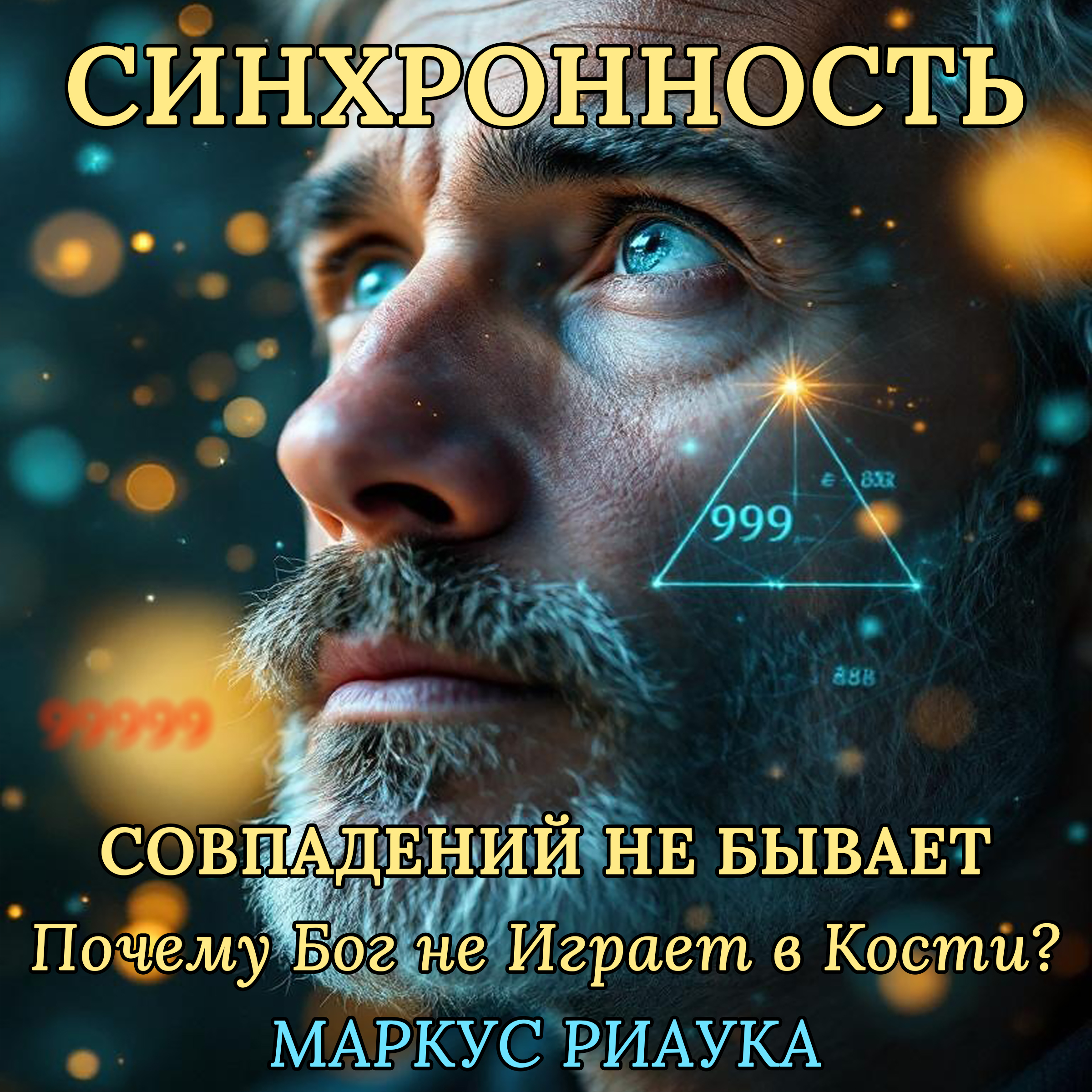
Десять глав. Механизм за синхронизмом, наконец раскрыт.
Юнг дал имя явлению. Паули искал его физику. Никто не нашёл механизм. До сих пор.
Эта книга строит модель — Спящий Шаблон — в которой реальность предварительно вычислена внутри Разума и проецируется последовательно. Синхронизм — не магия и не совпадение. Это функциональный сигнал, встроенный в архитектуру системы для удержания узла на пути самопознания. Это инженерный ответ на вопрос, который Юнг и Паули так и не смогли решить.
Фундамент: сознание первично, физическая реальность — его отрендеренный выход, мозг — фильтр, а не генератор осознания. Трудная проблема сознания как трещина в фундаменте физикализма. Три принципа, на которых стоит вся книга.
Ядро книги. Реальность предварительно вычислена внутри Разума и проецируется последовательно. Иерархия шаблонов от космического до узлового масштаба. Свобода воли как влияние на пересмотр шаблона. Онтологический порог — водопад между до-проявленным и проявленным.
Дорожное испытание модели. Проблема измерения, эксперимент Уилера, теорема Белла, эффект наблюдателя — каждая загадка квантовой механики находит естественное объяснение в архитектуре шаблона. Рекурсивная игра: сознание исследует само себя.
Время — не среда реальности, а порядок проекции. Будущее существует как текущий черновик — реальный, но редактируемый. Пророческий доступ как чтение черновика. Гениальность как исключительный доступ, а не исключительная вычислительная мощность.
История концепции синхронистичности. Юнг дал имя без механизма. Паули искал мост к физике, но не нашёл. Нью-эйдж превратил феномен в чувство без концепции. Модель шаблона как мост, который Юнг и Паули искали.
Конкретный механизм синхронистичности. Подсказки — не послания и не награды, а функциональные сигналы, встроенные в шаблон для удержания узла на пути самопознания. Четыре ошибочных интерпретации: награда, личное послание, особый статус, предсказание.
Почему сигнал различается от человека к человеку. Три уровня: невидимая рука, невозможный момент, непрерывный сигнал. Три маркера подлинного сигнала. Параллели в околосмертных, созерцательных и психоделических свидетельствах.
Свобода воли внутри авторской реальности. Две ошибки: фатализм и отрицание. Градиент свободы. Влияние, а не первотворение. Пограничная стена — прямое вмешательство системы. Свобода как присутствие подлинного выбора внутри ограничений.
Не блаженство, не любовь, не просветление — снижение энтропии. Большой взрыв как вступительный ход. Сложность как ценность. Карма как память шаблона — не моральная ведомость, а устойчивость неразрешённого паттерна.
Что автор знает, что предлагает, и почему различие между опытом и моделью имеет значение. Честность как метод. Путь важнее истины. Приглашение читателю проверить модель в единственной лаборатории, которая имеет значение — собственном прожитом опыте. Случайностей не бывает.
All titles are distributed globally through Author's Republic. Search "Marcus Riauka" on any platform below.
Marcus Riauka is a consciousness researcher and author whose work explores the nature of reality, identity, and the intelligence behind physical existence. Drawing on direct experience with altered states of consciousness, he writes at the intersection of philosophy, simulation theory, and spiritual awakening — without the spiritual packaging.
His work synthesises Vedic cosmology, quantum physics, and direct experience into a framework accessible to anyone willing to question what they were taught. He lives in Europe and writes for anyone who has ever suspected that what they see is not all there is.
Conversations at the Edge of Reality is his ongoing spoken-word series — now five titles. Season One introduced the framework. Season Two goes deeper into the source code of existence itself. Season Three — the real disclosure. DMT: The Name Your Soul Knows takes the investigation into psychedelic territory. And СИНХРОННОСТЬ brings the complete framework to Russian-language audiences for the first time.